






Will VENG Stock Go Up? Vision Energy Price Outlook

If you’ve been searching for “will VENG stock go up,” you’ve probably already noticed the number that makes most investors pause: Vision Energy Corporation (OTC: VENG) trades for a fraction of a cent. This isn’t a typical growth stock question. It’s a question about whether a nano-cap, sub-penny OTC company has any realistic path back to relevance.
Short answer: right now, the data doesn’t support a confident yes. VENG carries almost every red flag associated with distressed micro-cap stocks — near-zero market capitalization, thin trading volume, a history of reverse splits, and heavy dilution risk. That doesn’t mean the price can never move, sub-penny stocks can spike hard on speculation, but it does mean any upside case has to be weighed against serious downside risk.
Below is a breakdown of where VENG stands, what would need to happen for the stock to climb, and what could keep it stuck near zero.
VENG Stock Snapshot
| Metric | Detail |
| Ticker | VENG (OTC) |
| Company | Vision Energy Corporation (formerly Vision Hydrogen Corporation) |
| Sector | Renewable / low-carbon energy infrastructure |
| Headquarters | Jersey City, New Jersey |
| Founded | 2015 |
| Recent share price | Roughly $0.0015 |
| 52-week range | Approximately $0.0001 – $0.01 |
| Market capitalization | Around $12,600 (effectively nano-cap) |
| Average volume | Under 1,000 shares per session |
| Dividend | None |
| Reverse splits | 1-for-5 completed in June 2023 (third split in company history) |
Numbers this small mean a handful of trades can move the percentage change dramatically, so day-to-day quotes should be treated as noise rather than a trend.
What Vision Energy Actually Does
Vision Energy Corporation develops midstream infrastructure for importing, storing, and distributing low-carbon energy products and hydrogen carriers. The company was known as Vision Hydrogen Corporation until it rebranded in November 2022, shifting its story from pure hydrogen development toward broader energy infrastructure and import/storage terminals, visit more.
That’s a capital-intensive business model. Building storage terminals and supply-chain infrastructure requires large amounts of funding, and a company with a market cap in the thousands of dollars has almost no internal capacity to fund that kind of buildout without issuing new shares.
Why VENG Trades at Sub-Penny Prices
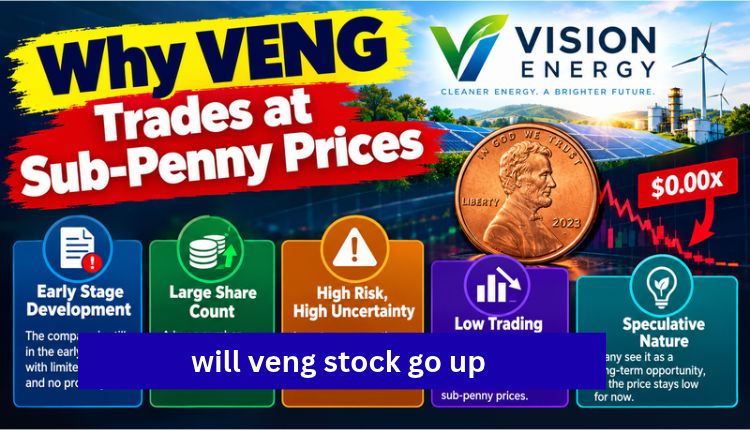
A few factors explain the current valuation:
- Repeated reverse stock splits: Vision Energy has executed multiple reverse splits, including a 1-for-5 split in June 2023. Reverse splits reduce share count to prop up the per-share price, but they don’t change the underlying market cap, and they’re often followed by renewed declines once the adjusted price resumes trading.
- Minimal revenue: Public filings show little to no reported revenue, which makes traditional valuation metrics like P/E ratios meaningless here.
- Thin liquidity: With average daily volume well under 1,000 shares, even small buy or sell orders can swing the quoted price by double-digit percentages without reflecting any real shift in company value.
- Dilution risk: Distressed micro-caps frequently raise cash by issuing new shares or convertible notes, which increases share count and puts downward pressure on price even if the business itself is stable.
Corporate Developments Worth Watching
A few recent items are relevant to anyone tracking whether sentiment could shift:
- Leadership changes: Vision Energy has seen director resignations alongside an announced stock buyback, moves that sometimes signal a company trying to clean up its cap table, though buybacks on stocks this thinly traded have limited practical effect on price.
- Sector tailwinds: Broader policy conversations around U.S. energy independence and infrastructure investment occasionally put small energy names back in front of speculative traders, even when the underlying company hasn’t changed its fundamentals.
- Project updates: Prior company statements referenced environmental assessments, marine simulation studies, and pre-FEED (front-end engineering design) work tied to its terminal projects. Any concrete progress, permits, financing, or partnership announcements, on these fronts would be the kind of catalyst that could move the stock meaningfully.
None of this guarantees a rally. It just outlines the categories of news that traders in this stock tend to react to.
Arguments For VENG Moving Higher
- Low float, high volatility: Because so few shares trade, positive news or a promotional push can cause outsized short-term percentage gains.
- Energy infrastructure narrative: If the company secures funding, a partner, or regulatory approval for its import/storage projects, that would be a fundamental reason for renewed interest.
- Speculative rotation: Sub-penny stocks sometimes catch bids when retail traders rotate out of larger positions looking for cheap, high-beta plays.
Arguments Against VENG Moving Higher
- Going-concern pressure: Companies with minimal revenue and a market cap this small typically face ongoing questions about their ability to fund operations without diluting shareholders.
- Reverse split history: A pattern of reverse splits generally signals a company struggling to maintain exchange or investor confidence in its share price, and it’s not unusual for the price to keep drifting down afterward.
- No analyst coverage: VENG doesn’t carry a consensus price target or meaningful institutional research, so there’s no independent benchmark validating a higher valuation.
- Execution risk: Energy infrastructure projects are expensive and slow. Delays, cost overruns, or failed financing rounds are common in this space for companies of VENG’s size.
How to Track VENG Before Making a Decision
Given how thinly traded and news-sensitive a stock like this is, checking current data before acting matters more than usual. If you’re building a habit of monitoring small, sentiment-driven tickers, it helps to see how other micro-cap and OTC names get tracked. For comparison, see how retail sentiment gets summarized for names like TRKAQ on Stocktwits or GNS Stock Twits, and how a broader forecast is framed on the NVOS Stock Forecast page. Watching how similarly small, volatile companies get discussed can help set realistic expectations for what VENG’s own price action might look like.
It’s also worth checking a live quote directly through your broker or a real-time data source before placing any trade, since sub-penny prices can shift between the time an article is published and the time you act on it.
VENG vs. Other Distressed Micro-Caps
VENG isn’t the only sub-penny or heavily diluted stock that gets searched for “will it go up.” Some traders compare notes across similar names before deciding where to allocate speculative capital. If you’re researching this category more broadly, pages covering NVOS stock price today, the NVOS stock price target, Key Corp sentiment, and CDIO’s stock forecast can offer useful side-by-side context on how different micro-cap stories tend to play out.
Frequently Asked Questions
Is VENG stock a good investment right now?
Based on available data, VENG carries characteristics common to high-risk, distressed micro-caps: minimal revenue, a market cap near zero, low liquidity, and a history of reverse splits. It isn’t possible to call this a confident “good investment” without a clear, funded catalyst. Anyone considering it should treat it as a speculative position only, not a core holding.
Why is VENG stock price so low?
The combination of limited revenue, a capital-intensive business model, repeated reverse splits, and thin trading volume has kept the per-share price in sub-penny territory. Reverse splits raise the nominal price temporarily but don’t fix the underlying valuation drivers.
Could VENG stock go up in 2026?
It’s possible. Sub-penny stocks can move sharply on low volume, and any concrete progress on financing, permits, or partnerships for its energy infrastructure projects could act as a catalyst. But without that kind of news, there’s no strong fundamental case for a sustained move higher.
Does Vision Energy Corporation pay a dividend?
No. The company does not currently pay a dividend, which is typical for early-stage, capital-intensive infrastructure companies still working toward revenue generation.
Where can I check the current VENG stock price?
Because prices on stocks like this can change quickly on very little volume, check a live quote through your broker’s platform or a real-time market data source rather than relying on a static figure from any single article.
Is VENG stock a risky investment?
Yes. Based on its market capitalization, trading volume, and financial profile, VENG falls into the highest-risk category of publicly traded stocks. Position sizing and risk tolerance matter more here than with larger, more established companies.
Conclusion
The honest answer to “will VENG stock go up” is that nobody can say with certainty, and anyone claiming otherwise is overselling their confidence in a stock with this profile. Vision Energy Corporation shows the classic markers of a distressed, thinly traded micro-cap: a market cap near zero, minimal revenue, and a track record of reverse splits. A move higher isn’t impossible, sub-penny stocks can spike quickly on news or speculation, but it would likely take a concrete catalyst, such as new financing, a completed project milestone, or a partnership announcement, to shift the fundamental picture rather than just the trading noise.
If you’re following VENG, treat it as a high-risk, speculative watch rather than a conviction buy, confirm live pricing before acting, and size any position according to how much volatility you can genuinely tolerate. This article is for informational purposes only and isn’t financial advice; consider speaking with a licensed financial advisor before making investment decisions.