

NVOS Reverse Split: Full History, Ratios & What It Means
If you’ve held NVOS stock for any length of time, you’ve probably noticed your share count doesn’t match what you remember buying. That’s not a broker error. Novo Integrated Sciences has gone through a reverse split before, and the topic keeps coming up because the stock’s price history makes people nervous about it happening again.
This guide breaks down the NVOS reverse split — what actually took place, why the company did it, and what it tells you about where the stock stands today.
What Is a Reverse Stock Split, Quickly
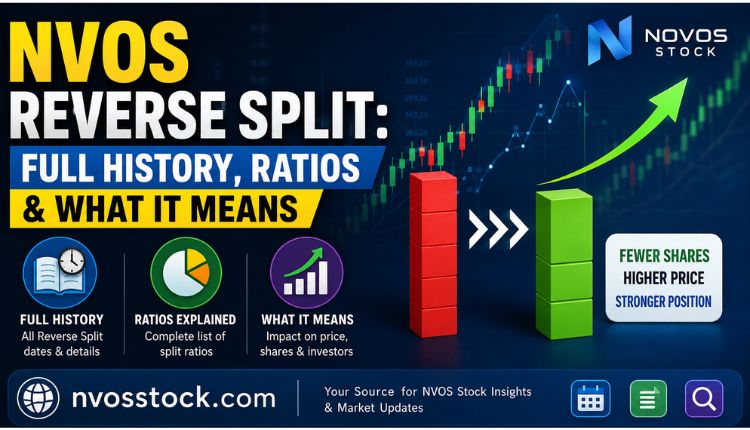
A reverse split reduces the number of shares outstanding while raising the price per share by the same ratio. A 1-for-10 split turns 10 old shares into 1 new share, and a $0.10 stock becomes a $1.00 stock overnight. Nothing about the company’s actual value changes — market cap stays the same, just sliced into fewer, pricier pieces.
Companies do this for one main reason: exchange compliance. Nasdaq and other major nvos reverse split exchanges require a minimum bid price (usually $1.00) to keep a listing. When a stock drifts below that for too long, a reverse split is often the fastest way to get back above the line.
The NVOS Reverse Split Timeline
Novo Integrated Sciences has actually done this twice. Here’s the full picture.
| Date | Ratio | Reason | Result |
| February 1, 2021 | 1-for-10 | Uplisting application to Nasdaq Capital Market | Stock briefly traded as NVOSD before reverting to NVOS |
| November 6–7, 2023 | 1-for-10 | Regain compliance with Nasdaq’s minimum bid price rule | New CUSIP (67011T300); shares consolidated |
The 2021 split came as Novo prepared its application to move up from the OTC market to Nasdaq. Reducing the share count and lifting the price was a prerequisite for that listing, and the company temporarily traded under the ticker NVOSD for about 20 business days before returning to its usual NVOS symbol.
The 2023 split was a different story — this one was defensive. By late 2023, NVOS shares had fallen well under Nasdaq’s $1.00 minimum bid price requirement. Rather than risk delisting, the board approved another 1-for-10 consolidation, effective after the close on November 6, 2023, with shares trading on a split-adjusted basis the next day. CEO Robert Mattacchione framed it at the time as the most workable option after exploring other ways to satisfy the listing rule.
Every 10 shares became one, and fractional shares were rounded up rather than cashed out — a detail worth knowing if you were holding an odd number of shares going into either split.
Where NVOS Stands Now
Since the 2023 split, the stock has continued to slide, and Novo now trades on the OTC market rather than Nasdaq. If you’re tracking the current numbers, our NVOS stock price and analysis page and the broader NVOS overview walk through the latest quotes, volume, and what’s been moving the price lately.
A couple of things are worth understanding if you’re watching this stock:
- It’s a low-priced, thinly traded name: Quotes have shown fractions-of-a-cent pricing with a market cap in the low single-digit millions, which means even small trades can swing the price sharply in a single session.
- The swings have been extreme: The stock has moved 80% or more within a year in both directions, including a reported drop of roughly 97% from a prior high.
- It’s no longer Nasdaq-listed: NVOS trades on OTC Markets, which comes with lower liquidity and lighter reporting requirements than a major exchange.
Does a Reverse Split Change What the Company Is Worth?
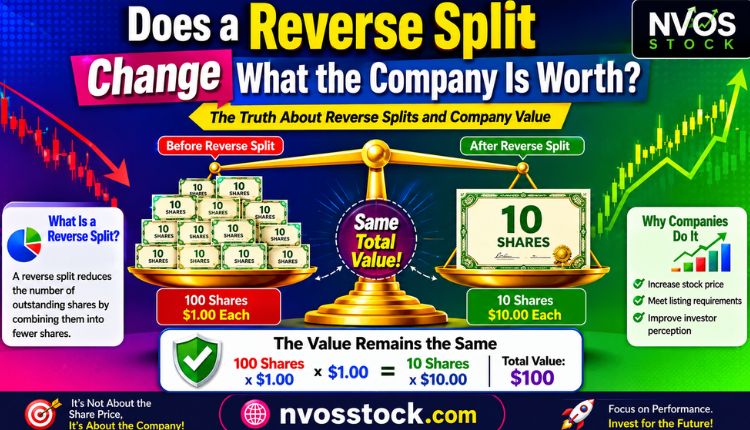
No — and this is the part that trips people up. A reverse split is arithmetic, not value creation. If you owned 10,000 shares worth $0.05 each before a 1-for-10 split ($500 total), you’d own 1,000 shares worth $0.50 each after it (still $500). Your percentage ownership of the company doesn’t move.
What a reverse split can signal is more important than the mechanics: a company doing this defensively, to avoid delisting, is usually telling you its stock has struggled for a sustained period. That’s context worth weighing alongside the company’s fundamentals, not a standalone red or green flag, visit more.
Could NVOS Do Another Reverse Split?
Nobody outside the company can say for certain, but the pattern nvos reverse split is worth noting. NVOS has now used a reverse split twice in under three years, both tied to exchange-related price thresholds. Since the stock has fallen further since the 2023 split and now trades on OTC Markets rather than Nasdaq, the pressure that triggered the last two splits — a share price too low to satisfy listing standards — isn’t really a factor on OTC in the same way it was on Nasdaq. Any future split would more likely be tied to a renewed uplisting attempt than to compliance risk on the current exchange.
If you want the background on the company itself — what it actually does and how its healthcare business segments are structured — our full breakdown of Novo Integrated Sciences covers that in more depth, and this look at the stock’s volatility is useful if you’re trying to understand the price swings around these events.
How to Verify Reverse Split History Yourself
Don’t take any single source’s word for corporate actions like this. A few reliable ways to double-check:
- SEC filings — Reverse splits require an 8-K filing and often a proxy statement. Search NVOS on the SEC’s EDGAR database directly.
- Official press releases — Novo has announced both splits via Business Wire, which is searchable and archived.
- Your broker’s corporate actions notice — Brokers typically notify you directly when a reverse split affects your holdings, including the new share count and cost basis adjustment.
- Nasdaq/OTC Markets listing pages — These show CUSIP changes and effective dates tied to corporate actions.
FAQs About the NVOS Reverse Split
When did Novo Integrated Sciences do a reverse stock split?
Twice — a 1-for-10 split effective February 1, 2021, tied to its Nasdaq uplisting application, and another 1-for-10 split effective after the close on November 6, 2023, to regain compliance with Nasdaq’s minimum bid price rule.
What was the NVOS reverse split ratio?
Both splits used the same ratio: 1-for-10. Every 10 shares held became 1 share after each split.
Did the reverse split change how much my NVOS shares were worth?
No. A reverse split adjusts share count and price nvos reverse split proportionally — your total position value stays the same at the moment the split takes effect. Any change in value afterward comes from normal market trading, not the split itself.
What happened to fractional shares in the NVOS reverse split?
Novo rounded fractional shares up to the next whole share in both splits, rather than cashing shareholders out for the fractional amount.
Is NVOS still listed on Nasdaq after the reverse split?
No. Despite the 2023 reverse split, NVOS currently trades on the OTC market, not Nasdaq.
Could NVOS do another reverse split?
It’s possible, especially if the company pursues another Nasdaq uplisting in the future, but there’s no confirmed plan as of now. Any such move would require board and shareholder approval and an SEC filing, both of which would be publicly disclosed in advance.
Conclusion
The NVOS reverse split isn’t a single event — it’s happened twice, for two different reasons: one offensive (getting onto Nasdaq), one defensive (staying on it). Neither changed what the company was actually worth, but both reflect a stock that’s had a genuinely difficult run.
If you’re holding or considering NVOS, understanding this history matters less for predicting the next corporate action and more for reading the bigger picture: a low-priced, high-volatility stock with a track record of needing structural fixes to meet exchange standards. Keep an eye on the current stock analysis for updated pricing, and treat any reverse split news the same way you’d treat any other material corporate action — verify it against SEC filings before acting on it.