




VENG Stock Price Today: Vision Energy Corp (OTC) Overview

If you’ve searched for the VENG stock price, chances are you landed on some conflicting numbers. That’s not a mistake on your part — VENG is a thinly traded OTC ticker, and the data feeds don’t always agree on the last print. Here’s what’s actually going on with the stock, why it moves the way it does, and what to watch before you put any money near it.
What Is VENG Stock?
VENG is the ticker for Vision Energy Corporation, an energy company working on midstream infrastructure — think import terminals, storage, and distribution — for low-carbon energy products and hydrogen carriers. The company was originally called Vision Hydrogen Corporation before it rebranded to Vision Energy in November 2022. It’s based out of Jersey City, New Jersey, and trades on the OTC markets rather than a major exchange like the NYSE or Nasdaq.
That OTC listing matters more than people give it credit for. It means lower liquidity, wider bid-ask spreads, and a stock price that can swing hard on almost no volume at all.
Current VENG Stock Price Snapshot
As of the most recent trading data available, VENG has been changing hands around $0.0015 a share — squarely in penny-stock territory. To put that in perspective, the stock’s 52-week range runs from roughly $0.0001 up to $0.01, so even “small” moves in absolute cents translate into massive percentage swings.
A few data points worth knowing:
- The stock has dropped around 85% over the trailing twelve months.
- Average daily volume is minimal, often in the hundreds of shares rather than thousands or millions.
- Market capitalization sits in the tens of thousands of dollars, not millions — a sign of just how micro-cap this name really is.
Because pricing on illiquid OTC tickers can lag or vary by source, always check a live quote from your broker before making any decision. Numbers you find on aggregator sites can be delayed or based on a stale last trade.
Why Has VENG Stock Been So Volatile?
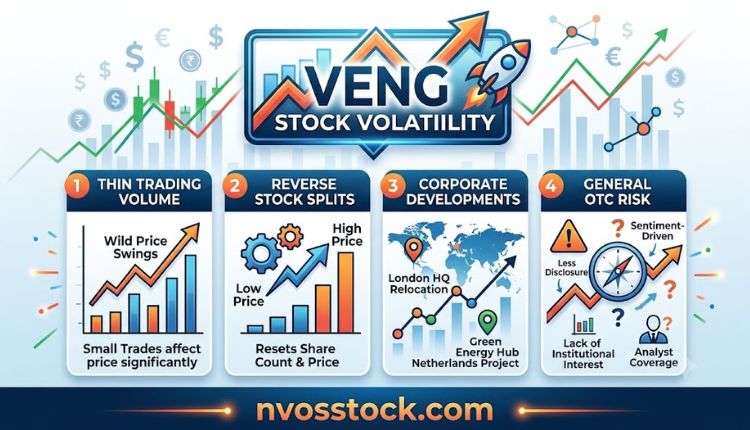
A few things explain the wild swings:
Thin trading volume: When only a few hundred shares trade in a day, a single buy or sell order can move the price by double digits in percentage terms. This isn’t unique to VENG — it’s just how micro-cap OTC stocks behave.
Reverse stock splits: Vision Energy has gone through at least one reverse split, which resets the share count and price but doesn’t change the underlying value of the company. If you’re comparing historical charts, make sure you know whether they’re split-adjusted, or the numbers will look meaningless.
Corporate developments: News like the planned relocation of its headquarters to London or updates on its Green Energy Hub project in the Netherlands has moved the stock, sometimes sharply, on news days.
General OTC risk: Many OTC-listed companies, including this one, don’t have the same disclosure requirements, analyst coverage, or institutional interest as exchange-listed stocks. That means price discovery is messier and sentiment-driven.
Is VENG Stock a Buy?
This is the question everyone actually wants answered, and the honest response is: it depends entirely on your risk tolerance, and this isn’t the kind of stock where “the fundamentals support it” is a satisfying answer either way.
A few things to weigh before you consider it:
- No consensus rating: There’s no meaningful analyst coverage on VENG, so you won’t find a price target or buy/sell/hold consensus like you would with a large-cap name.
- Financial health is thin: Revenue, net income, and operating cash flow figures are minimal or not reported in a way that gives a clear picture of the business.
- Speculative by nature: Penny stocks like VENG are often driven more by speculation, promotional activity, or short-term catalysts than by earnings growth.
If you’re drawn to VENG because it’s cheap, remember that a low share price alone tells you nothing about value. A $0.0015 stock can lose 90% of its remaining value just as easily as a $50 stock can, and often more easily, given the lack of liquidity.
How to Track VENG Stock Price
If you decide to keep an eye on VENG, a few practical tips:
- Use your brokerage’s real-time quote rather than a free aggregator, since OTC data can be delayed by 15–20 minutes or more elsewhere.
- Check trading volume alongside price — a price move on 200 shares means something very different from a move on 200,000 shares.
- Look up recent SEC or OTC Markets filings directly rather than relying on secondhand summaries, especially before any trade.
- Set a price alert rather than checking manually, since moves can happen quickly on thin volume.
Comparing VENG to Other Small-Cap and Speculative Tickers
VENG isn’t the only ticker that draws attention for being cheap and volatile rather than for strong fundamentals. If you’re researching one small or speculative stock, it’s worth widening the lens. We’ve covered similar ground on names like NVOS stock, where Novo Integrated Sciences has seen its own share of price volatility, as well as social-sentiment-driven names discussed on Stocktwits for CDIO, GNS, and TSLY. Reading a few of these side by side is a good way to see how similar patterns — thin volume, sharp swings, heavy retail chatter — show up across completely different sectors.
If your interest in VENG stems from the broader energy or biotech speculation trade, it’s also worth reading up on names like the Ozempic stock symbol or the Novo Nordisk stock forecast for a sense of how a heavily covered, large-cap name behaves differently from a micro-cap OTC ticker like VENG.
The Bottom Line
VENG stock price action is a case study in what happens when low liquidity meets high speculation. The company itself is working in a legitimate space — low-carbon energy infrastructure — but the stock trades more like a lottery ticket than an investment right now, given the size, the volume, and the lack of institutional coverage. If you’re considering a position, size it accordingly, verify pricing directly with your broker, and don’t mistake a low share price for a low-risk one.